
- Details
Public lecture „Die Geburt stellarer Monster - Über die Entstehung der massereichsten Sterne im Universum“
 We are pleased to invite you to the public lecture “Die Geburt stellarer Monster - Über die Entstehung der massereichsten Sterne im Universum " (in German).
In his talk, Rolf Kuiper will explore how the most massive stars in the cosmos are formed, which are rare in number, but extremely bright. He will connect the latest insights from astrophysical simulations with brand-new observations of young, massive star-forming regions that have only recently become accessible.
When 25.6.25 at 20:00
Where Planetarium Bochum
For registration and further information, please have a look at the Planetarium’s homepage.
Picture:
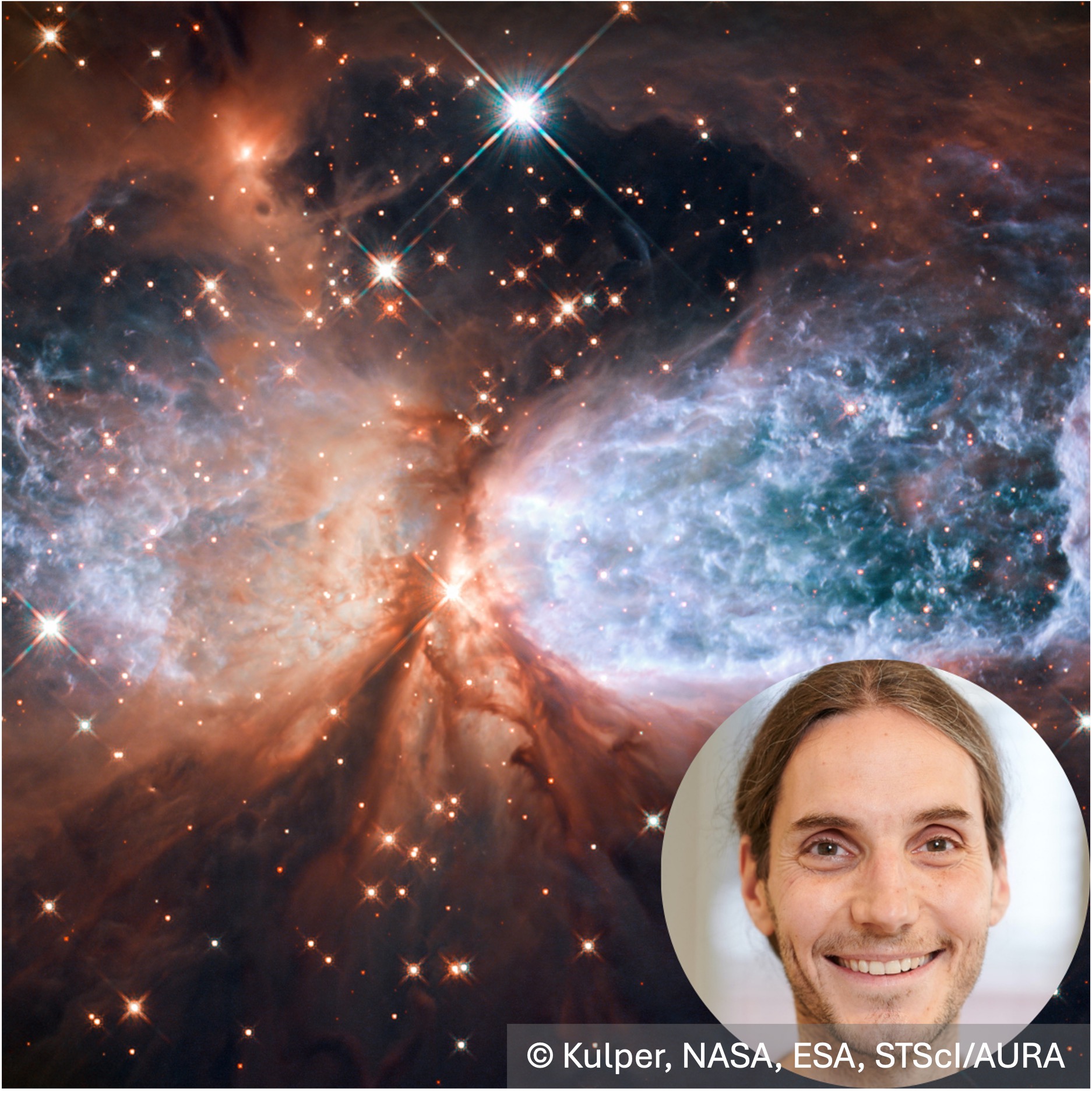
In the S 106 region, about 2,000 light-years from Earth, a particularly massive star is being born.
- Details
RDM Workshop
 From May 12 to 13, the 4th Workshop on FAIR Data in Plasma Science (FDPS-IV) took place online and in-person at the Leibniz Institute for Plasma Science and Technology (INP) in Greifswald, Germany. This workshop was a continuation of annual events on research data management in the low-temperature plasma community. Ranging from general presentations on frameworks for research data management and the creation of suitable ontologies towards hands-on examples on the use of electronic lab books during student’s practical exercises, recent developments within the field have been discussed. This workshop provided a valuable platform to exchange experiences and ideas on future implementations, .as research data management following the FAIR-principle (findable, accessible, interoperable, reusable) becomes more and more important within the community. In particular the use of an electronic lab book has been topic of several contributions. Thanks to the organizers Marina Prenzel (RUB), Andreas Schramm (RUB), Markus Becker (INP) and Kerstin Sgonina (CAU Kiel) for this valuable opportunity to exchange expertise.
- Details
Congratulations to Prof. Julia Tjus!
 We are happy to announce that our spokesperson Julia Tjus has been officially named an Honorary Doctor of the Chalmers University of Technology as of May 24, 2025.
This prestigious recognition was awarded during the university’s annual academic celebration in the Gothenburg Concert Hall.
Julia has been honored for her groundbreaking contributions to astroparticle physics. Her pioneering work in neutrino astronomy and cosmic ray research, especially her collaboration with the IceCube Neutrino Observatory, has significantly advanced our understanding of the high-energy universe. Since her postdoctoral stay in Gothenburg, she has maintained a close connection with Chalmers University. As a Jubilee Professor in 2023 and now as an Associate Professor, she continues to strengthen the strong partnership with Nordic radio and neutrino astronomy.
We also extend our congratulations to the new doctors of Chalmers University, the honorary doctors Babak Hassibi (CalTech), Herre van der Zant (TU Delft), and Marcus Wandt (Saab/Esa), and Chalmers Supervisor of the Year Yinan Yu.
Please also have look at the news articles of Chalmers
and RUB News
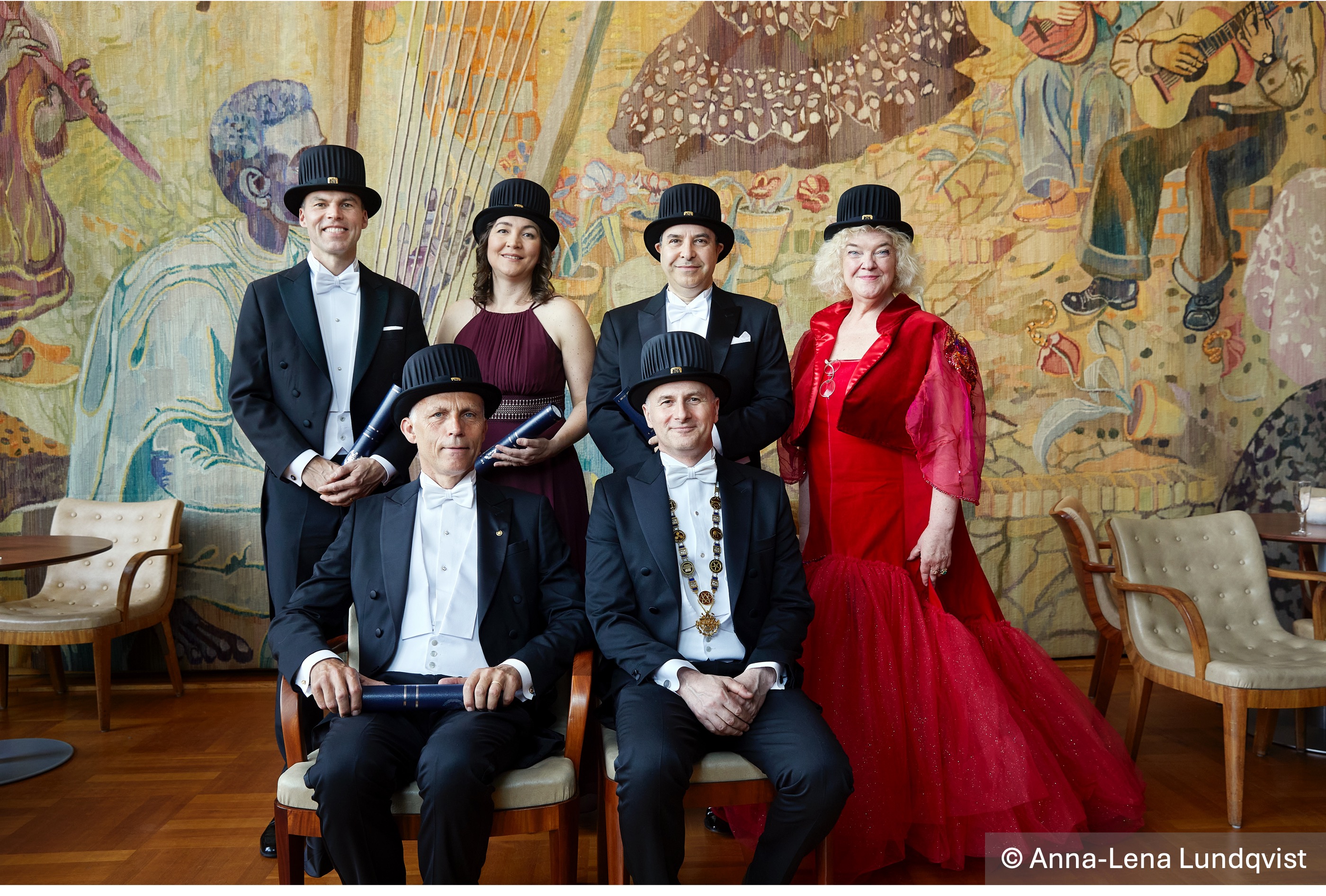
Picture: All honorary doctorates: front: Herre van der Zant, Martin Nilsson Jacobi (President of Chalmers University), back: Marcus Wandt, Julia Tjus, Babak Hassibi, Eva Olsson (Chair of the Faculty Council)
- Details
IDEA-2025 Science Slam winner: Sruthi Ravikularaman!
Congratulations to the new CRC associate and DARK100 postdoc Sruthiranjani Ravikularaman!
Sruthi won the Science Slam at IDEA.2025 — the first Entrepreneurship Day hosted by the Worldfactory Start-up Center (WSC) of Ruhr University Bochum!.
In her winning talk Afraid of the dark? she brilliantly explained the concept of dark matter using the analogy of ghosts. She also discussed the unique dark matter detection experiment of the Dark100 project with PANOSETI telescopes.
The judges praised her ability to address complex challenges in her field with a blend of humor and insight, making her presentation both informative and entertaining.
This award gives Sruthi the unique opportunity to attend the Falling Walls Summit in November in Berlin:
Read more about the IDEA.2025 event here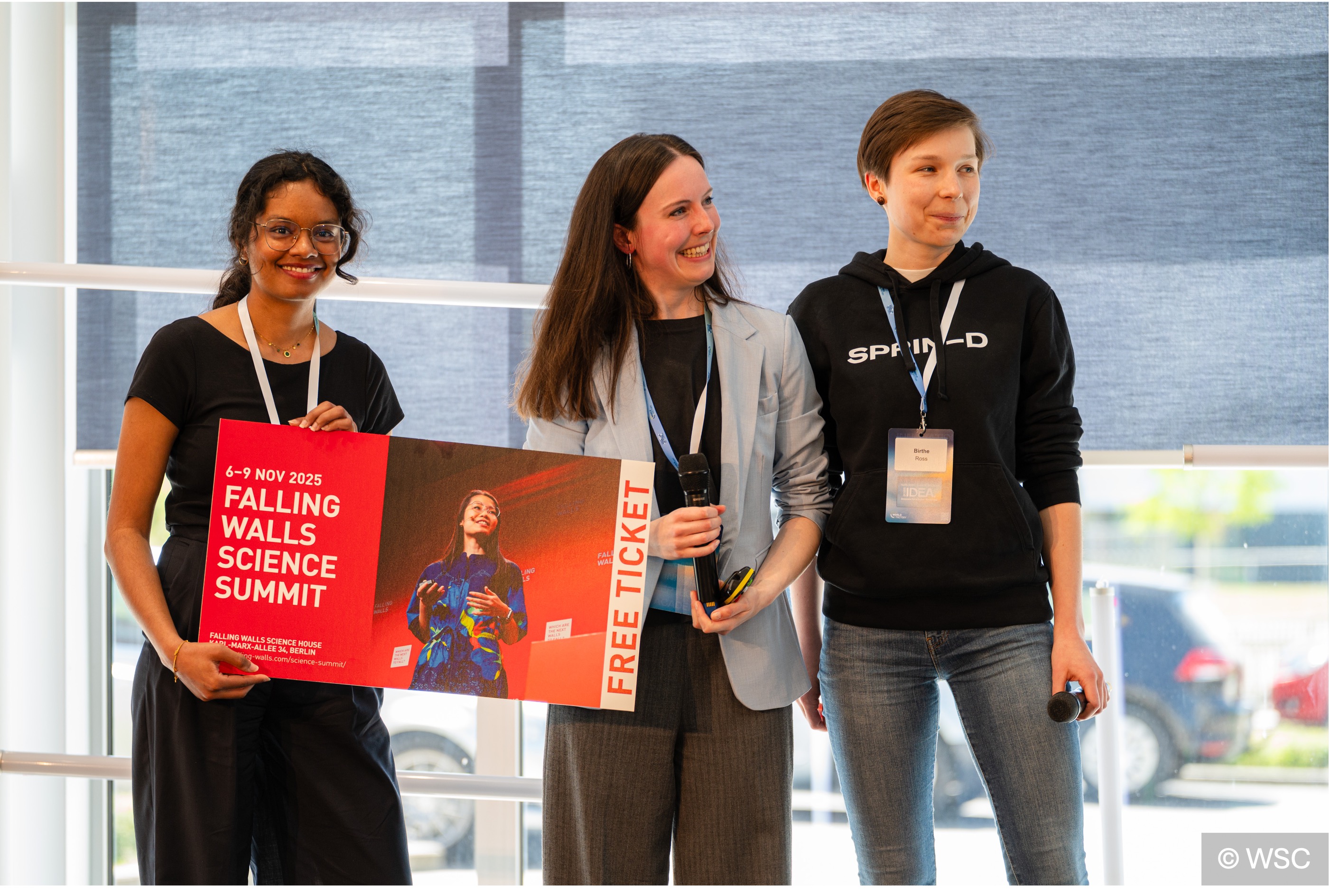
- Details
IceCube Impact Award 2025
Congratulations to the SFB1491 members Giacomo Sommani and Niclas Krieger for receiving the IceCube Impact Award 2025!
The IceCube Impact Awards recognize significant contributions to IceCube - the neutrino observatory at the South Pole.
Giacomo received the Individual Impact Award for his outstanding work on the performance and robustness of the reconstruction of IceCube real-time alerts.
Niclas is part of the team that was honoured with the Group Impact Award for the development of the next-generation online and offline filtering and event selection for all IceCube data.
More information on the awards can be found
here.
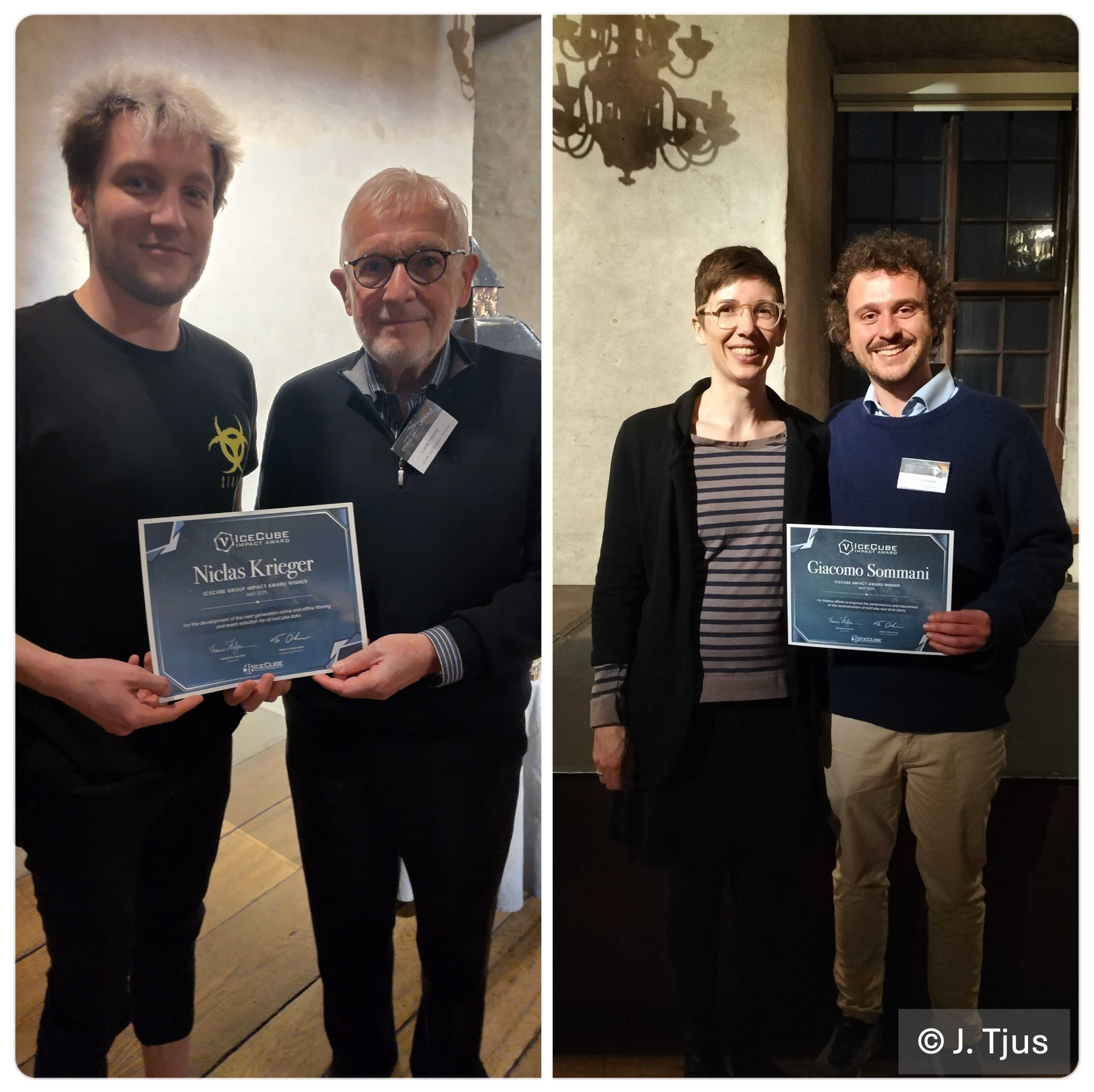
Picture: Niclas (left) and Giacomo (right) with collaborators.
- Details
Plasma Science for the 21st century - CRC1316 presents its goal to the National Teachers Congress
The 115th MNU congress took place in Bochum 1st-4th of May 2025. Judith Golda and Achim von Keudell presented a lecture on plasma science of the CRC1316 in combination with a few experiments from the plasma truck portfolio. A large audience was impressed and inspired by the enormous range of applications of plasmas.
- Details
Public lecture „Licht aus Dunkler Materie “
We are pleased to invite you to the public lecture “Licht aus Dunkler Materie " (in German).
Elisa Pueschel will present exciting new results and perspectives in the search for the mysterious Dark Matter, and show how her ‘Dark100’ project is breaking new ground with innovative approaches to uncovering this elusive form of matter.
When 30.4.25 at 20:00
Where Planetarium Bochum
For registration and further information, please have a look at the Planetarium’s homepage.
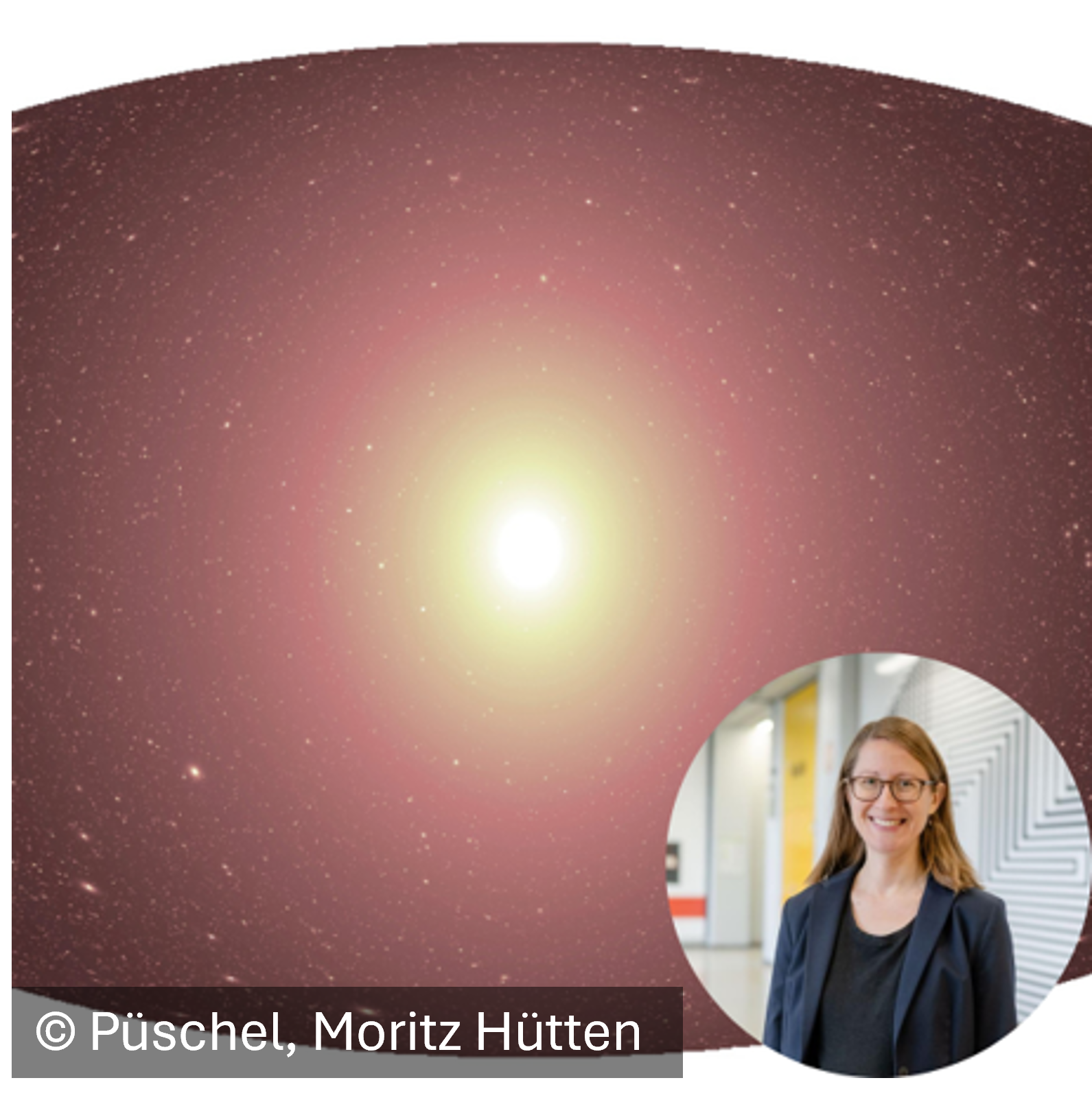
Picture:
A possible sky map if Dark Matter indirectly produces radiation through rare interactions.
- Details
High school student interns at EP2
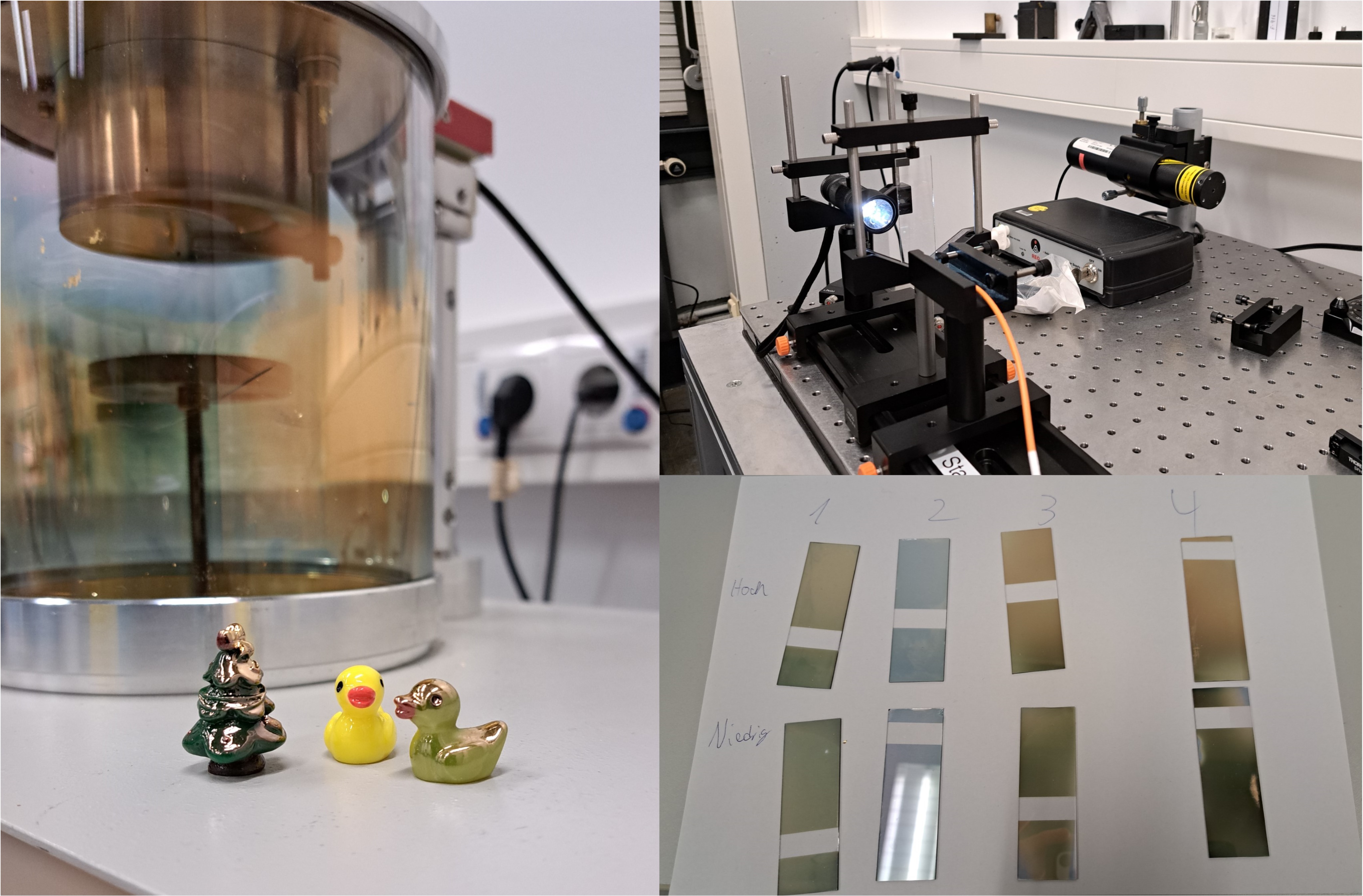 From 9th to 11th April, two high school students were guests at the Chair of Experimental Plasma Physics. They experimented with the sputter coater, gained insight into current plasma research at the Ruhr-Universität and observed scientists at work.
- Details
Research stay at CSIRO Perth
As part of his PhD project, Sam Taziaux spent two months at the renowned CSIRO Institute in Perth, Australia. There he worked closely with George Heald, head of the SKAO headquarters in Perth, and Alec Thomson, both internationally recognised experts in the field of radio astronomy and the analysis of magnetic fields.
Sam's research project, which is part of A2, is dedicated to analysing cosmic ray transport and magnetic fields in dwarf galaxies. At CSIRO, he was able to benefit from the exceptional expertise there and was able to significantly improve the data reduction and analysis of his observed ATCA and MeerKAT data.
The stay was not only a great professional enhancement for Sam, but also a significant milestone in his scientific career, as he was able to get to know and work with the people from the CSIRO and SKAO. He was also able to establish contacts with the scientist at Curtin University in Perth to exchange ideas and expand his network.
Such research stays are excellent opportunities enabled by the CRC to specifically promote international cooperation. The CRC has thus opened up a unique opportunity to become involved in a global scientific network at an early stage, an invaluable advantage on the path to scientific independence.
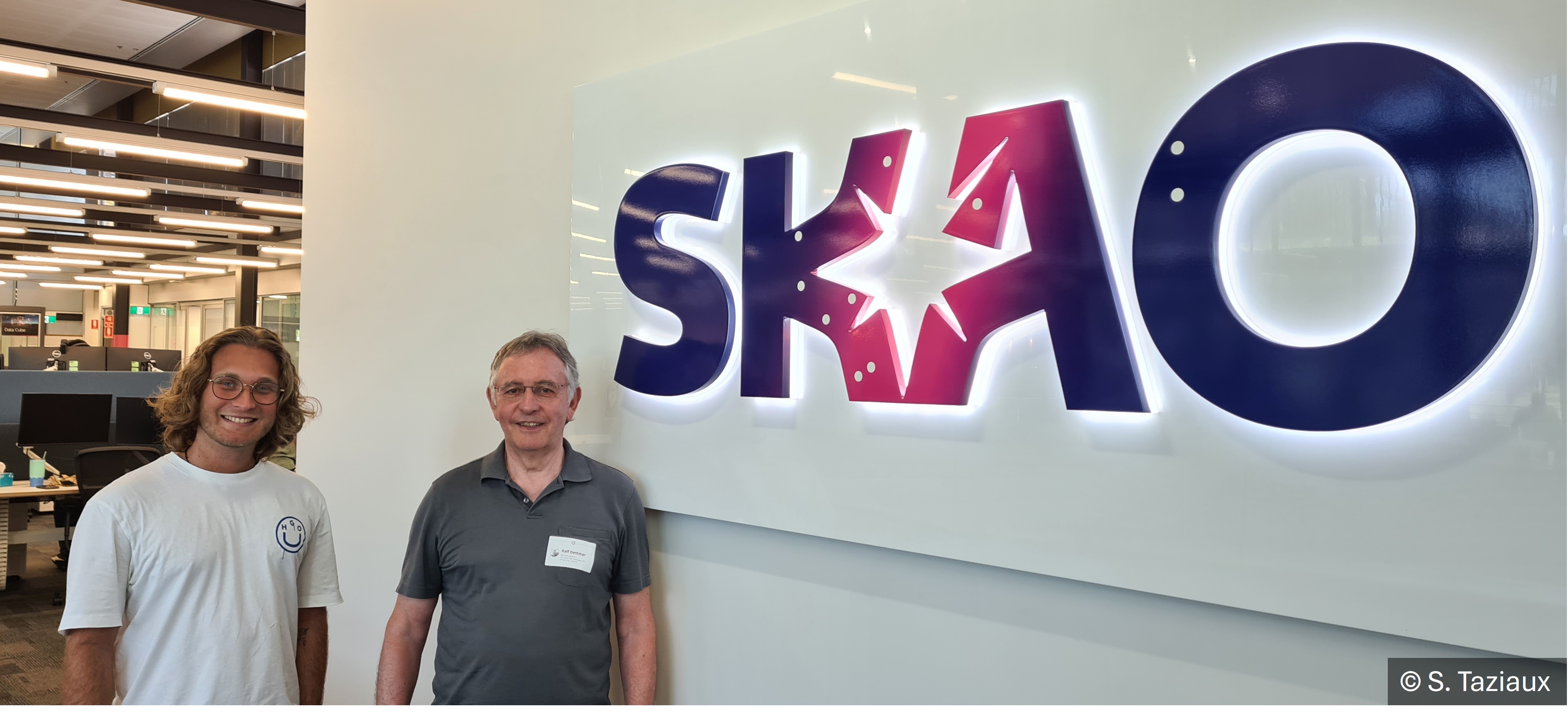
Picture: Sam Taziaux and his supervisor Ralf-Jürgen Dettmar at the SKAO regional center at CSIRO, Perth.
- Details
DPG Göttingen 2025
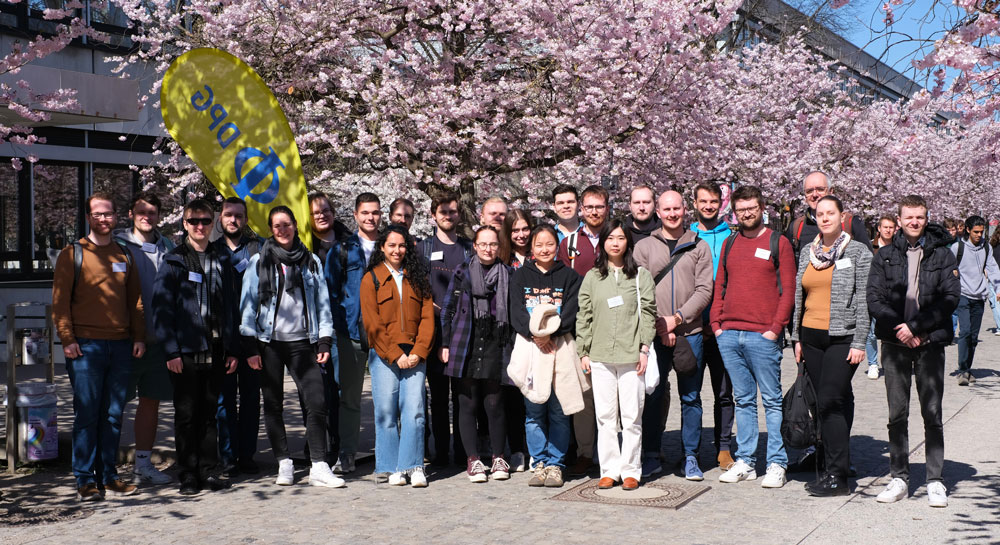
From March 31 to April 4, 2025, the spring conference of the German Physical Society (DPG), Matter and Cosmos Section, took place in Göttingen.
The SFB 1316 participated in the spring conference with three invited lectures, numerous presentations, and poster presentations. With these contributions, we not only presented the research work of the SFB 1316, but also sought to engage in active exchange with researchers in order to strengthen the network and good cooperation.
- Details
Announcement for the 4th Workshop on FAIR Data in Plasma Science
We are happy to announce the 4th Workshop on FAIR Data in Plasma Science (FDPS-IV), which will take place online and in-person on
12-13 May, 2025 at the Leibniz Institute for Plasma Science and Technology (INP) in Greifswald, Germany.
This workshop is intended to provide an overview of successful solutions for collaborative research data management with the goal to make data findable, accessible, interoperable and reusable (FAIR). It is a continuation of annual events on research data management in the low-temperature plasma (LTP) community in the past years. Open for everyone, the FDPS-IV workshop provides insights into best practice in day-to-day research work as well as infrastructure tools for handling of research data. To even broaden the discussion on future applications, a poster session will be held in-person.
Call for poster contributions
Researchers, data managers, and practitioners are invited to contribute to the discussion with a poster on their solutions on research data management. Submissions that highlight real-world experiences, best practices, and insights related to the integration of FAIR principles into research workflows are encouraged.
Registration
The workshop will be held as a hybrid meeting and participation is free of charge. Please save the date and register by following the registration link on the workshop website: https://www.plasma-mds.org/ws-fair-data-plasma-science-4.html.
Poster contributions must be submitted during the registration process. Please note that the attendance in person at INP and the number of poster spaces is limited, so early registration is encouraged to secure your spot (max. DIN A0, portrait format).
The registration will be closed on 4th May, 2025.
Contact
The workshop organization is part of the activities of the working group Experimental Plasma Physics at the Kiel University (CAU), the INF project of the CRC 1316 at the Ruhr-University Bochum (RUB) and of the department Plasma Modelling and Data Science at Leibniz Institute for Plasma Science and Technology (INP).
Dr. Markus Becker
Leibniz Institute for Plasma Science and Technology (INP)
Felix-Hausdorff-Str. 2
17489 Greifswald
Germany
E-mail: